
Introduction
Workato held its WOW conference in Las Vegas from August 18th to August 20th at The Cosmopolitan. This blog post covers recent Workato announcements along with some of the information shared at a briefing for industry and financial analysts on August 19th.
The integration and automation market is experiencing a significant shift. The challenge is moving beyond connecting apps and transferring data. With increased adoption of AI, the goal now is to coordinate intelligent, autonomous agents that can securely and efficiently carry out end-to-end business processes at scale. Workato, long known as a leader in iPaaS, has repositioned itself as the champion of this “Agentic Enterprise.” With these announcements, Workato has communicated a strategy designed to reshape enterprise automation itself.
Recent Announcements by Workato
Workato ONE: A Unified Foundation
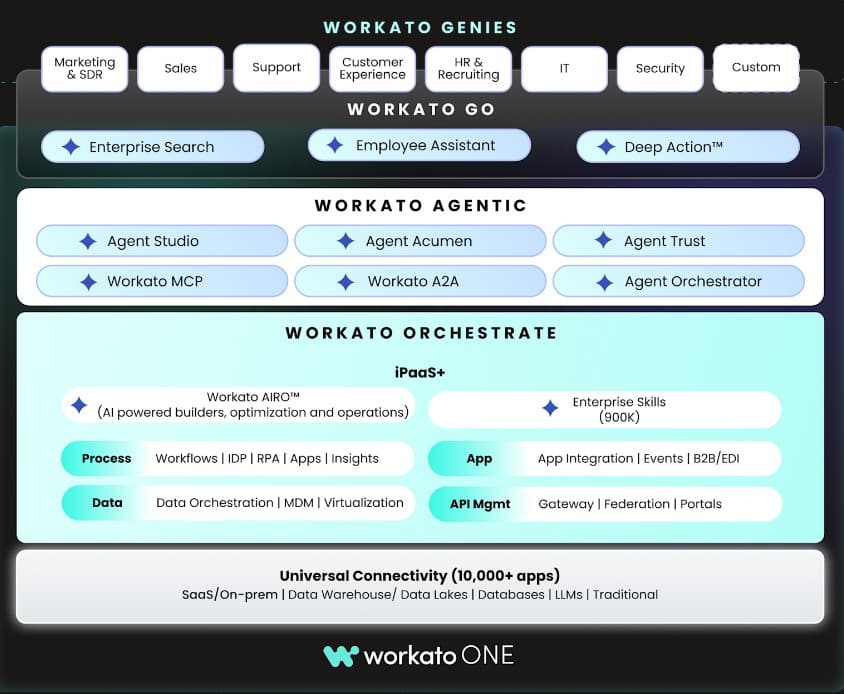
As shown in Figure 1, Workato ONE provides the core architecture for the Agentic Enterprise vision. Instead of assembling separate tools for integration, RPA, and AI, Workato ONE delivers a single, seamlessly integrated platform. This consistency sets it apart from competitors, who often rely on acquisitions to expand their portfolios. For customers, this translates to a unified governance model and fewer gaps that can lead to project failures.
Workato GO: The Super App for Work
Workato GO, launched in June 2025, acts as a command hub for employees. Enterprise-wide search is integrated with “Deep Action” features that allow staff to find information across more than 8,500 applications and take immediate steps. This expands Workato’s reach from IT to all employees’ workflows, using automation to boost company-wide productivity.
Agentic and Genies: Enterprise AI Agents
Workato approaches AI agents from two complementary perspectives. First, Genies are pre-built, production-ready agents that are packaged for core business functions, such as Sales, HR, and IT. These go beyond simple chatbots by orchestrating complex, multi-step workflows across enterprise systems right out of the box. Second, for organizations wanting to design their own, Workato’s Agent Studio provides a visual environment to build and govern custom agents using reusable skills, enterprise context, and secure orchestration. Together, this model enables enterprises to adopt turnkey Genies or develop tailored agents — while maintaining consistency, governance, and integration with over 10,000 applications. Industry-specific Genies are also on Workato’s roadmap.
AI Copilots and AIRO: Speeding Time-to-Value
Workato’s suite of Copilots, ranging from Recipe Copilot to Connector Copilot, leverages AI to accelerate integration. Combined with AIRO (Automation Idea to Outcome), Workato reduces the development cycle from concept to implementation. These features directly meet enterprise needs for quicker ROI and cut reliance on scarce, costly developer resources.
Data Pipelines and Enterprise Orchestration
The quality, relevance, and structure of the data influence the accuracy, fairness, and usefulness of AI insights and models. Weaknesses in any of these attributes can limit the value of AI-driven decision-making. Because data is crucial for AI, Workato introduced Data Pipelines to handle high-volume replication and synchronization. This feature helps ensure that analytical systems and AI models receive the most up-to-date data. Data Pipelines indicate that Workato is transitioning from being a mere iPaaS vendor to becoming an orchestration platform that can unify data, processes, and AI.
Workato AI Research Lab: Driving AI-First Innovation
In mid-August 2025, Workato announced the opening of its AI Research Lab in San Francisco, led by Adam Seligman, CTO of Workato. The lab demonstrates a commitment to becoming an AI-first company. With the help of partnerships with academic and industry organizations, the lab will focus on developing applied AI technologies for automation, orchestration, and the creation of intelligent agents. This move reflects a long-term plan to provide advanced AI tools to customers, while also considering governance and ethics. While many companies collaborate with customers online, a brick-and-mortar research lab provides Workato with a unique platform to host customers and partners, accelerating enterprise automation.
Impact on Customers
For Workato customers, these announcements signify a shift from “integration plumbing” to direct business impact. Business teams now have self-service access to automation through Workato GO and Genie Apps. IT can oversee technology use with governance and security. This enables customers to achieve faster value realization, reduce risks associated with AI adoption, and scale their operational AI. Workato is helping customers move from intelligence to action with AI.
Impact on Competitors
Workato’s competitors are all adopting the agentic narrative, but employing different approaches. For instance, MuleSoft emphasizes developer-centric governance within Salesforce’s ecosystem, while Boomi highlights no-code agent development and extensive data integration. Zapier offers lightweight AI automation aimed at SMBs. Workato’s unique position is in combining enterprise-scale governance with an easy-to-use interface, providing AI orchestration for both IT and business users. This makes Workato especially attractive to diverse enterprises that prioritize speed and simplicity without losing control.
Impact on Investors
Workato is repositioning itself as an AI company by providing AI agents coordinated with customer data, applications, and workflows, built on its leading iPaaS platform. Investors need to assess if this new category of products will appeal to customers and help Workato expand its market share. At the conference, Workato reported an average of 54% CAGR over the past four years with a $150M investment in new features, signaling momentum and ambition for the company. Workato aims to lead not only in integration but also in shaping the next-generation orchestration market.
Conclusion
At the analyst event, Vijay Tella, Workato’s CEO, emphasized that integration is no longer just a plumbing issue but a front-end business challenge. This was clear as Workato’s announcements went beyond product updates to redefine enterprise automation. Workato’s unified platform democratizes agent development and incorporates AI across the entire stack. Workato is shifting its portfolio from simply connecting apps to orchestrating intelligent enterprises. The message to customers, competitors, and investors is clear: the future of automation is agentic, and Workato aims to lead the way.